
Foraging and AI
ChatGPT will never be a better forager than you.

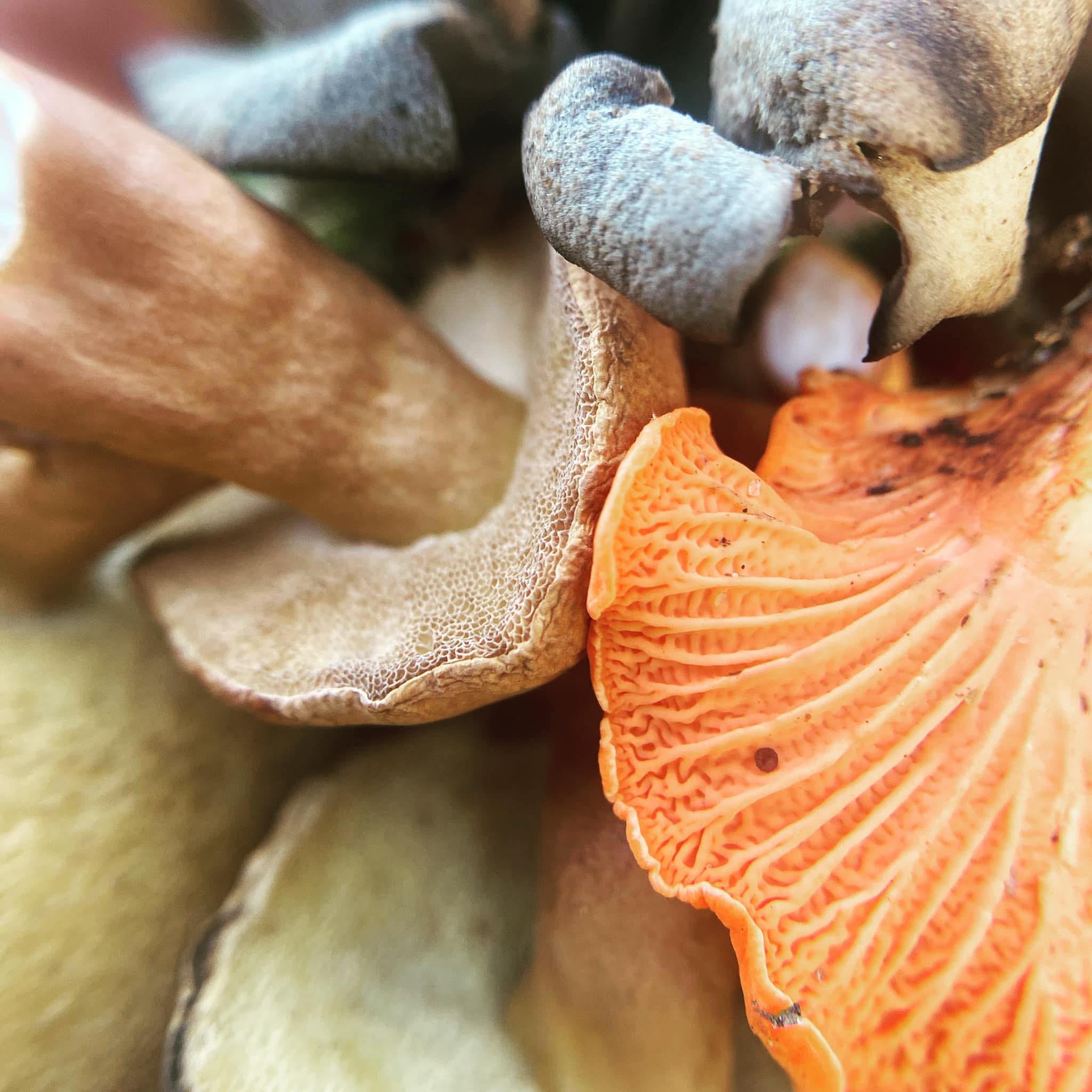
As a professional foraging educator, I have dozens of friends and acquaintances who contact me with relative frequency to ask exactly one question, usually accompanied by a photo: “Can I eat this?”
Sometimes, the answer is yes. Sometimes, the answer is no. Often, the answer is “can you try taking a few photos during the daylight hours from fewer than 7 feet away?”
However, over the past couple of years, the question has taken on a somewhat concerning change. “ChatGPT say this is XYZ. Can I eat it?”
Foraging has grown more popular in recent years, fueled by cycles of pandemic cabin fever, climate anxiety, the rising price of groceries, and growing mistrust in the systems that govern our health and safety, coinciding almost perfectly with the new digital Wild West that is the current LLM (large language model) boom and subsequent integration of AI in nearly aspect of our lives. More people than ever are turning to field guides, content creators, and local educators like myself to learn what they can safely harvest from the wild. However, they are also turning to tools that feel safe and trustworthy, tools like LLMs which promise to do the heavy mental lifting for you, providing “reliable” information within seconds.
The current moment captures both the promise and peril of a world where artificial intelligence is being asked to mediate our most basic forms of knowledge – even using it as a filter to reality-check our own observations and experiences. It’s easy to see why people are tempted to use AI as a shortcut. AI promises endless, customized advice for nearly every situation. The appeal is obvious. Who wouldn’t want an experienced guide in their pocket – one who is always available and never makes you feel stupid or inadequate?
But here’s the uncomfortable truth: no algorithm, no matter how sophisticated, can replace lived ecological knowledge.
Setting aside the cognitive dissonance of using AI despite the alarming ecological issues with AI data centers (which used more drinking water than the entire disposable water bottle industry in 2025, among other alarming statistics), the first problem with using AI as a foraging ID tool is that it lies. Confidently, frequently, and unapologetically. This isn’t malicious, of course, but it is a serious problem. LLMs are notorious for what researchers call “hallucinations”: a combination of trained sycophancy and a clumsy grasp of the soft skills of critical evaluation which causes them to invent information that sounds plausible but simply isn’t.
For those who use them, it is obvious that the programming prioritizes user enjoyment over honesty. Frequently, it outputs an offputting soup of plagiarized material from dozens of sources, some of which may be more reputable than others. A sarcastic retort on Reddit may be misinterpreted by a LLM and taken as genuine advice, which is synthesized into its responses to user queries. “I don’t know” is rarely something ChatGPT will admit, but is an unskippable part of both plant and mushroom identification, a process which requires meticulous and multisensory information-gathering to ensure accuracy beyond what any eye, human or otherwise, can assess. The difference between a prized edible and a so-called “toxic look-alike” often comes down to subtle details like the texture of a mushroom stipe or the scent of a crushed leaf; observations that can only be recognized with the precise intuition of human senses. These are not things AI can reliably perceive or explain.
It is also a (terrifying) fact that LLMs are used by an increasing number of ill-meaning scam artists in order to trick unsuspecting consumers by creating slapdash, self-published books that look legitimate but contain no actual research, curation, or fact-checking. When I checked the top 25 titles in Amazon’s “foraging books” category just this morning, eight of them were AI generated, many of them designed to mimic titles written by genuine experts, and perhaps the most horrifying piece: they were all marketed to beginners. Beginners tend to believe that the information contained in foraging books is tested and trustworthy, and they lack the practice to identify bad advice. And unfortunately, these fake-out AI books aren’t just a theoretical problem – some have actually led to real-world sickenings and hospitalizations. Almost all of these books contain AI-generated illustrations of plants and fungi that either fabricate or omit vital details, inaccurate descriptions, and made-up authors with fabricated credentials to boot. Right now, anyone can publish an AI-generated field guide on platforms like Amazon with essentially no oversight at all. In fact, a recent survey found that over 80% of book titles in the “herbalism” category on Amazon released between January and October 2025 likely either contained AI generated content or were completely AI generated.
None of this is to say that digital tools have no place in foraging or broader ecological work. Used carefully, it can connect beginners to communities of practice, translate obscure scientific papers, and even help map the effects of climate change on species ranges. The deeper issue here is cultural: we’ve grown accustomed to outsourcing knowledge to algorithms. For many tasks, it can be a harmless way to offload busywork. But for the ancient, place-based practice of eating from the wild, it’s not just inadequate, it’s dangerous. Foraging is not a trivia game to be outsourced to a chatbot. It is a skill, a culture, and a relationship with the land. And sometimes, it is a matter of life and death.
As someone who has spent years educating, foraging, learning, and writing about wild food (I’ve even written my own zero-AI foraging book: “Gathered: On Foraging, Feasting, and the Seasonal Life”), I believe that the rise of AI should make us more skeptical of the sources we choose to trust. If anything, the flood of algorithmic misinformation is a reminder of why real expertise matters, why embodied knowledge is irreplaceable, and why we must approach the natural world with humility, mutualism, and respect. AI’s biggest issue isn’t that it’s stupid (though it is rather stupid at a lot of things) – it’s that it strips the process of context and ignores valuable but often subtle information.
There’s also a deeper, unspoken irony to all of this. For much of human history, foraging was a quiet and commonly practiced form of resistance against systems like slavery, genocide, and colonization. Enslaved people in the American South were expert foragers, creating entire food and medicine systems that could supplement meager rations, serve as inter-community currency, even earn some money in a system that denied all their human rights. For hundreds of years, Indigenous communities have fought to preserve traditional gathering rights in the face of colonization and privatization, and have maintained foraging as a cultural right. Even today, foraging can be a way of rejecting industrial food systems that are similarly cruel, exploitative, and unsustainable. With all that history of struggle and triumph, delegating our knowledge of the land to algorithms built by mega-corporations that are actively wrecking the planet feels like a betrayal of the radical tradition of foraging.
So what should we do, in an age where this technology is increasingly inescapable?
First, we can advocate for responsible use of AI, and harder crackdowns on clear attempts to defraud people with substandard, dangerous foraging education. AI foraging books have no place in a society that claims to care about safety, responsibility, and trust. These books should not be for sale anywhere, and should be considered nothing short of a danger to public health. Learn to spot AI books, and always thoroughly investigate the author to verify their credentials and community ties.
Second, we can encourage people to use certain digital tools like iNaturalist and other respected ID apps as entry points, while being clear and honest about their limitations. When good information is provided (clear photos of multiple angles and specimens if applicable, accurate geotagging, and environmental details), these apps can be helpful, but they should always be cross-examined against other, more definitive sources, such as trusted field guides and expert identifiers.
And third, we can remember that the real reward of foraging isn’t in how we consume; it’s how we commune. With the natural world, with each other, even with ourselves. There is an intoxicating peace and contentment to be found in the process of seeking, harvesting, processing, sharing, and protecting wild food.
The real joy is not in a freezer full of mushrooms or in shelves full of jars, but in the work itself. It would be a waste to deprive yourself of that gift, the incomparable reward of work worth doing.